Introduction
Lost, and Found
In 1539 a Paris printer called Denis Janot put his name to a book he knew could ruin him. His shop stood in the shadow of Notre-Dame. He printed poetry, history and moral philosophy for respectable readers. In a chest owned by his father, he found a mysterious manuscript.
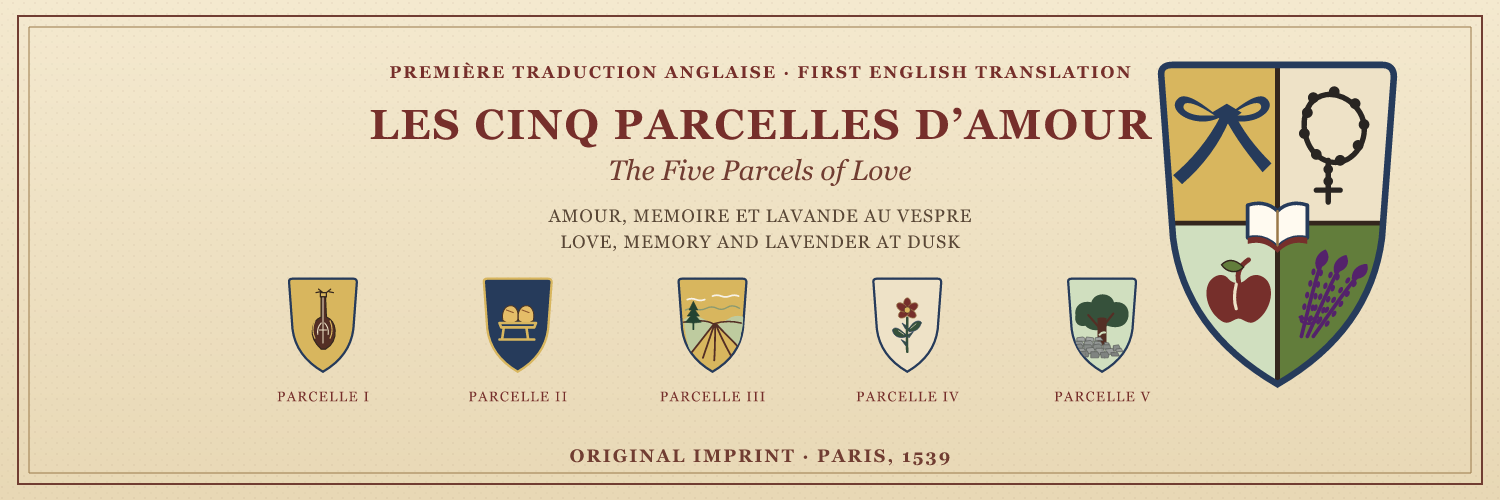
Les Cinq Parcelles d’Amour is the memoir of a noblewoman who signed herself only as Massan. It tells of the five women she loved, in her own words.
Paris was the worst place in France for a book like that. The theologians of the Sorbonne kept watch over the city’s presses, and printers who crossed them paid dearly.
The few copies that survived being pushed out on the black market went south.
Lyon was the other capital of French printing, and it answered to no university. It was the city where Rabelais first published Pantagruel, with its mockery of the Sorbonne. In 1585 the bibliographer Antoine du Verdier listed Les Cinq Parcelles d’Amour in his great catalogue of books in French. After that, nothing. No sale, no inventory, no other mention for nearly four hundred years.
In 1964 the old Renaissance quarter of Lyon was saved from the bulldozers, and over the following decade builders went house by house, stripping out centuries of plaster. Some time in the mid-1970s, in a merchant’s house near the cathedral of Saint-Jean, they opened up a chimney breast and found a parcel wrapped in waxed cloth. Inside were several volumes of the book, bound in calf gone as soft as a glove.
The builders had no idea what they had found. The book passed through a flea-market stall and a Paris dealer before crossing the Channel. For some years it sat on a high shelf in Cecil Court, the narrow lane of booksellers off Charing Cross Road.
This is that book, newly translated from the Middle French by an unknown hand.